

Finding the next customer is one of the hardest parts of running a landscaping business. Most of the time, you have to find them one at a time — through referrals, advertising, your website, social media, or simply years of building a reputation.
But there’s another source of customers with something most landscaping prospects don’t have: a deadline. And it’s parked at the end of driveways all over your service area.
Every FOR SALE sign represents a homeowner who, perhaps for the first time in years, has a financially obvious reason to care very much about how the property looks.
And standing beside that homeowner is another professional whose income depends on the house showing well.
The numbers are unusually solid. A study in the Journal of Real Estate Finance and Economics examined nearly 89,000 actual home sales and found that houses with strong curb appeal sold for about 7% more — and in slow markets, when listings sit, the premium climbed as high as 14%. That’s sale-price data, not opinion.
Consumer research out of Virginia Tech points the same way: going from an un-landscaped property to a well-landscaped one raised a home’s perceived value by roughly 5 to 11% — with design sophistication — not plant count — doing most of the work. To be precise: curb appeal covers the whole exterior, of which landscaping is the largest visible component.
Put it in dollars. On a $700,000 listing, even a 1% difference is $7,000. Against a relatively modest landscaping investment, suddenly the conversation isn’t about whether fresh beds and a cleaner front yard are worth the money. It’s about whether they might help sell a $700,000 asset.
But the numbers aren’t the best part. The best part is that you don’t sell the homeowners. You sell the agent – once.
Selling homeowners one at a time means making the case hundreds of times. Make it to a real estate agent once and the agent takes over the selling — not as a favour to you, but because it serves their commission and their days-on-market on every listing they take from now on. Better still, fifteen minutes at a brokerage’s weekly sales meeting puts the idea in front of an entire sales force. One conversation, and you have a pipeline. And that slow-market finding cuts your way too: the premium doubles exactly when agents are hurting most — when everyone else’s phone has stopped ringing.
What makes the pitch land isn’t a brochure. It’s a picture. Take the listing photo of the front yard, hand it to an AI image tool with a one-sentence instruction — clean bed lines, fresh mulch, defined edges — and in under a minute you’re holding the yard as it is next to the yard as it could be. The agent doesn’t describe anything to the seller. They turn the screen around. An estimate asks the homeowner to imagine the result. A picture lets them see it.
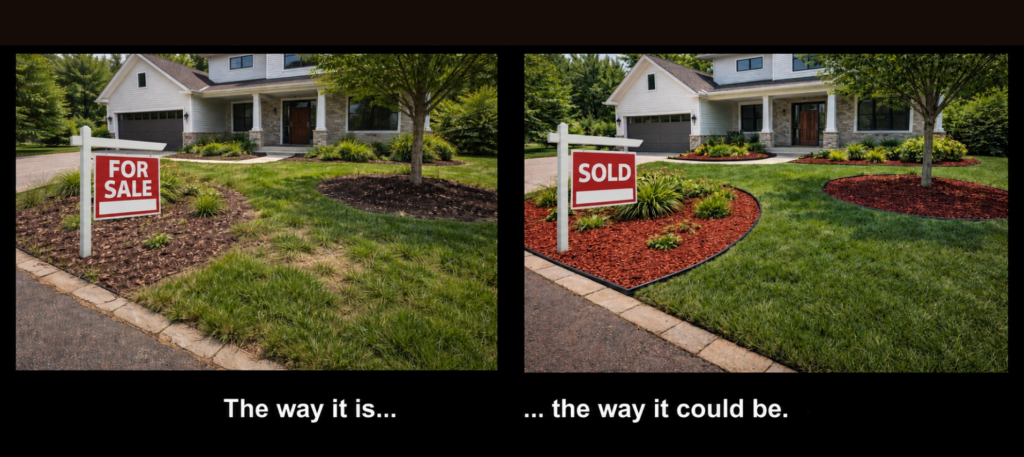
And notice what this play doesn’t ask of you. Most partnership pitches die quietly because they ask you to hand a customer relationship to someone else and trust that something comes back. This one keeps everything in your hands: you produce the picture, you meet the seller, you do the work. Just be clear-eyed about who the real customer is. The homeowner is one job — they’re moving, after all. The agent is a channel, and a channel keeps producing long after the sign comes down.
The cost of finding out whether this works in your market: a few AI renders, a few phone calls, one short presentation. The downside is an afternoon. The upside is a new source of customers.
The next time you pass a For Sale sign, don’t see a house. See a lead.
If you decide to test this: Fifteen Minutes in Front of the Right Room shows exactly what I’d take into that first brokerage meeting. →